
Why Your Matcha Latte Deserves a Premium Price Tag — And How Staff Education Gets You There
The science behind America's fastest-growing beverage — translated into talking points your team can use today.
A guest orders your matcha latte and asks:
"What makes matcha different from regular green tea?"
Your staff hesitates.
That moment matters more than most operators realize. Premium beverages don't sell on flavor alone — they sell on confidence, knowledge, and story. And right now, matcha has one of the most compelling stories in the industry.
Your Guests Are Already Sold — They Just Need Confirmation
60% of matcha buyers in the U.S. cite antioxidant content as their primary reason for choosing it. A growing segment — particularly Gen Z — are actively seeking what they call "crash-free energy": sustained focus without the afternoon slump that follows a double espresso. Matcha recipe searches on Pinterest have grown 200% since 2020, and overall social media mentions have more than doubled year-over-year.
These guests have done their research. What they're looking for, when they walk into your café, is validation. When your team can speak to the "why," a good matcha latte — whether it's priced at $7, $9, or $10+ — stops being an impulse order and starts being a deliberate choice. That's the difference between a one-time visitor and a regular.
The Science, Translated for Your Menu
Matcha is made from shade-grown tea leaves that are stone-ground into a fine powder. Because you consume the entire leaf — not just an infusion — the nutritional profile is markedly different from brewed green tea. Here are four compounds worth knowing:
Matcha contains significantly higher levels of this antioxidant than brewed green tea — widely discussed in wellness research for its potential role in supporting overall health.
Found at notably higher concentrations than in regular green tea. Has been associated with relaxed alertness — the reason matcha delivers calm, sustained focus rather than coffee's jittery spike.
The shade-growing process — leaves covered 20–30 days before harvest — produces a higher chlorophyll content. This is what gives high-quality matcha its vivid, electric green color.
Present at notably higher levels compared to other green teas. Of interest in wellness circles for its potential vascular benefits — a genuine functional story for citrus-paired menus.
You don't need all of this on your menu. But your team should be able to say, naturally: "Matcha has this amino acid called L-Theanine — it gives you focus without the coffee crash. A lot of our regulars switched from afternoon lattes for exactly that reason."
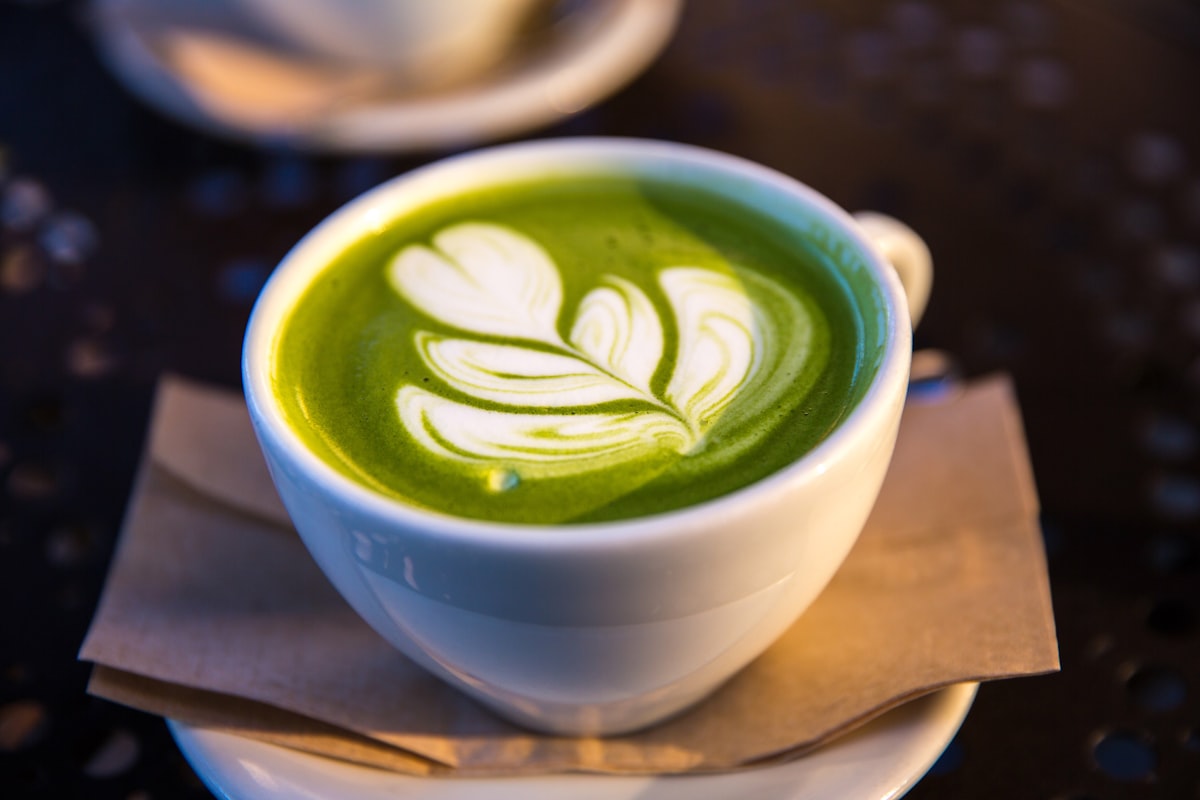
Photo: Pexels / Min An — Free to use
The Real Variable Isn't Origin — It's How the Matcha Performs in Your Cup
Most matcha conversations in the industry start with origin — Uji, Nishio, Kagoshima. But for operators building a menu around milk-based drinks, origin is only part of the equation. The more important question is: how does this matcha actually perform when it meets your milk?
Milk has fat, sweetness, and body. A matcha that tastes clean on its own can disappear completely into an oat milk latte. A ceremonial-grade product designed for whisking with hot water isn't necessarily optimized for the richness of whole milk or the subtle sweetness of oat. The matcha that makes the best drink is the one engineered for the final cup — not just the highest grade on paper.
This is why a well-designed matcha blend will sometimes intentionally include green tea powders with a stronger, more assertive bitterness. Not as a compromise — but as a deliberate counterbalance. Bitterness cuts through milk fat. It creates contrast. It's what keeps a $9 or $10 matcha latte from tasting flat or one-dimensional.
Think of it the way a roaster approaches a house espresso blend: the goal isn't to use the most expensive single-origin bean — it's to build something that holds up under pressure, steam, and milk, and tastes exactly right in the final glass.
Consistency Is the Other Half of Premium Pricing
There's a second challenge that doesn't get talked about enough: tea leaves change with the seasons. First-harvest leaves taste different from second-harvest. A warm spring produces different flavor profiles than a cool one. If you're buying the same product year-round from the same single source, the taste your guests fell in love with in March may not be what they're getting in October.
For operators who have built a following around their matcha, this seasonal drift is a real risk. Guests don't know why a drink tastes "off" — they just stop ordering it.
The solution is seasonal blending: adjusting the composition of the blend as harvest characteristics change, while keeping the flavor profile your menu is built around consistent cup after cup, season after season. It's the same principle behind how great coffee roasters maintain a house blend — the recipe shifts slightly to compensate for the raw material, so the finished product never does.
This is the kind of supply partnership that supports a $9–$10 price point with confidence. Not because the matcha is "rare" — but because the drink your guest orders today will taste exactly like the one that made them a regular six months ago.
Three Staff Talking Points Worth Memorizing
Train your front-of-house team on these three statements — keep them simple, keep them honest:
"Unlike coffee, matcha gives you focused energy without the crash. It's the L-Theanine — it works with the caffeine to smooth it out."
"The bright green color is actually a quality signal — it means the leaves were shade-grown properly. Dull or yellow-toned matcha usually points to a different production process."
"Our matcha is blended specifically to work with milk — the balance is calibrated so the flavor stays consistent whether you're using oat, whole, or almond. That's why it tastes the way it does."
These aren't hard sells. They're the kind of genuine, knowledgeable responses that turn a first-time guest into a regular — and a $9 latte into a $18 check when they come back with a friend who's "curious about that matcha thing."
Curious how a seasonally blended matcha performs in your café?
We work with café operators, chefs, and beverage teams to find the right matcha blend for their specific milk program — and to keep that flavor consistent as seasons change. If you'd like to taste the difference side by side, we're happy to arrange a sample for your team.
Request a Sample info@forbridges.co.jpPhotos: Unsplash — Free to use, no attribution required